
Recent Ruminations on Running
Three quick thoughts on running as a mode of transport.

Bipedal locomotion is incredible.
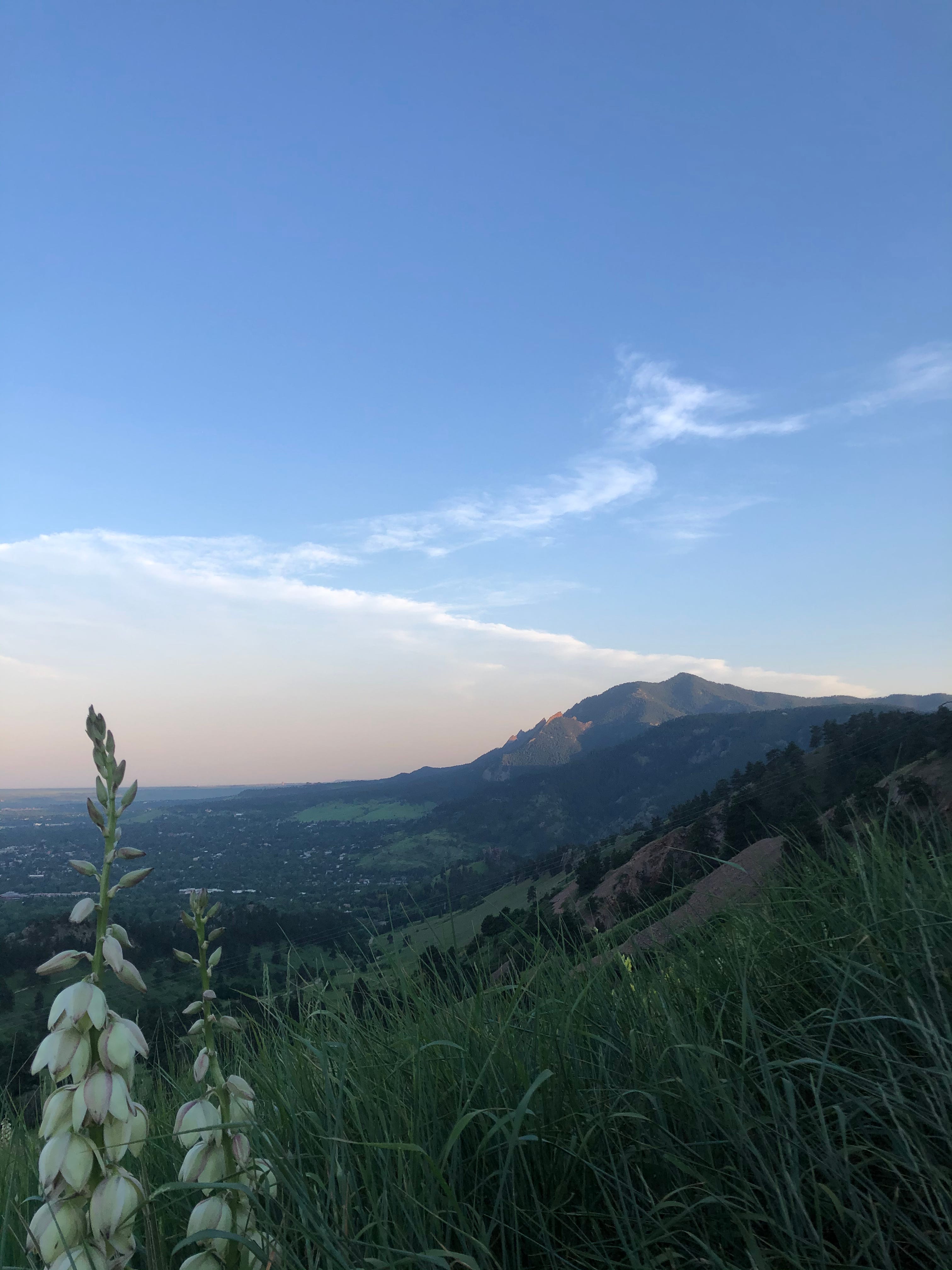
As I’ve descended trails by the Flatirons in recent weeks, flying downhill while hopping between rocks and jumping over tree roots, I’ve marveled at the natural ability of the human body to accomplish the mundane: not eating shit. We can sprint down rocky trails while holding a conversation with a friend and yet somehow, our brains are able to process the deluge of sensory information well enough to avoid disaster.
When you consider the amount of data your brain is sifting through at a given moment to keep you upright, you really appreciate the horsepower in your head. Your eyes, obviously, are providing the critical visual input that tells you where to place your next step while also looking ahead to stay on the trail or to dodge oncoming obstacles. More subtly, your sense of touch is generating data on the traction of the trail or how slippery the rocks are—even the push or pull of the wind can be a relevant data point. Your inner ear, in combination with your muscles and eyes, keeps your balance even as you move between unstable and uneven boulders or across shifty scree. Your sense of hearing can even play a role in your ability to discern the stability of your grip as pebbles crunch underfoot or you hear rocks shift under your weight.
When you’re running on a rocky trail, there exists an awareness that you are deeply focusing on foot placement, balance, and shifting your momentum to efficiently carry you across the terrain. All of the choices that lead you to place a foot on a given rock or put out your arms for balance, however, occur on a subconscious level. If you are in flow, running at your limit in technical terrain, you couldn’t possibly pick out the individual rocks yourself with sustained success. Interjecting conscious decisions into the movement workflow, in my experience, is often when ankles are twisted or you slip and fall.
This video is an incredible illustration of how the visual aspect of moving across rocky terrain. It comes from a study called Gaze and the Control of Foot Placement When Walking in Natural Terrain. Watch the video if only to see the gaze tracker in the top right calibrate furiously as the hiker moves across the rocky trail.
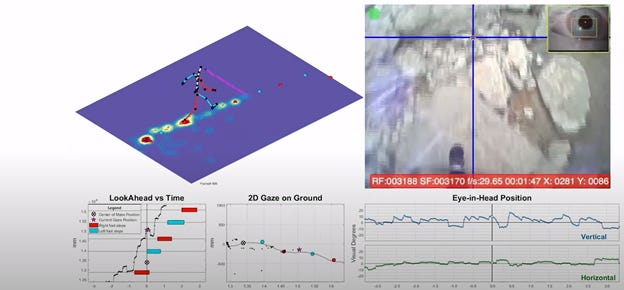
The study found that, in rough terrain, humans tend to plan about two steps ahead. Across different kinds of terrain, subjects adjusted where they were looking and what they were looking at “to ensure that they would always have a consistent degree of certainty about the upcoming path over the next 1.5 [seconds].”
Anecdotally, this ‘look-ahead’ time aligns with my experience. While running, I rarely find myself actually looking at my feet or directly where I am placing them next; instead, I am looking down the trail at future obstacles and, in a very subconscious manner, planning out my path through space. Apparently, researchers have noticed this 1.5 second look-ahead time in climbing stairs, driving, and reaching for objects. The prevalence of this number across different domains, the researchers write, suggests that 1.5 to 2 seconds may be a limit for visual memory. Interestingly, they posit that the reason people slow down in difficult terrain may not be related to an increased strain in executing the movements but rather a bottleneck of information processing; in order to maintain the ~1.5 seconds of path certainty in more complex terrain, which demands more information processing, people slow down.
Different modes of transport seem to highlight different sensory experiences. With all the running I’ve done lately, I’ve noticed running seems to highlight the noises around me that I normally miss with other forms of transport: the crunch of gravel under my shoes, the calls of birds soaring high overhead, the pattern of my breathing.
Interestingly, I also find I can easily miss important visual details when speeding along trails—recently, my friend Jake and I ran past a bear without noticing it, only realizing our near-miss when a hiker below us asked us about it—but will often notice seemingly inconsequential details. For instance, this week while running through my neighborhood I saw a colony of ants conducting an epic battle against some malignant invaders. Over the past month, the wildflowers in the Front Range, aided by plentiful afternoon showers over the summer, have been absolutely booming. When I was finishing a long run last weekend, the waves of a small lake I ran past were whipped up into whitecaps by the wind blowing across the prairie in a way that made me feel like I was running through a marsh in the brackish creeks of the North Carolina coast.