
Alaska Range 2026
Running the three-man in the Land of the Midnight Sun

“But let’s trade armor. The men must know our claim: we are sworn friends from our fathers’ days till now!” — Homer, The Iliad, Book 6, Lines 276-277
We sat in the Fairview Inn, drinking pitchers of cheap beer after spending the day rotting around the Talkeetna airstrip. The stormy weather had made our scheduled flight into the Alaska Range impossible. I joined Jake on the back patio, taking a break from the blaring live band to discuss base camp reading selections. While this was my first Alaska trip (and first time on a real glacier, and first time winter camping, and first expedition-style trip, etc), Jake had accompanied Ian and the rest of the group to the Pika Glacier last year. Like an old Alaska hand, Jake explained that we wouldn’t have much time to read, between skiing and camp duties. So, figuring it wouldn’t come out of the bag much, in a move later described by Ian as “Classic Michael,” the only book I brought onto the Kahiltna Glacier for our weeklong ski expedition was the Iliad.
“When a man’s exhausted, wine will build his strength—battle-weary as you are, fighting for your people.” — Book 6, Lines 310-311
Our Talkeetna lodging was The Bunkhouse, a well-insulated two-story shack available to customers of Talkeetna Air Taxi (TAT) suffering from weather difficulties. Waking up to a slight hangover, a dusting of snow, and an overflowing toilet, we returned to the airstrip at nine o’clock only to be rebuffed with an unconvincing “try again for a weather window at eleven.” There were eight of us total: Ian and Ben as guides, then myself, Jake, the two Andrews, Tony, and Joe. We crowded into Conscious Coffee to hammer burritos, drink espressos, and read from their library. We all wanted to get on the glacier (and, importantly, to avoid another night in The Bunkhouse).
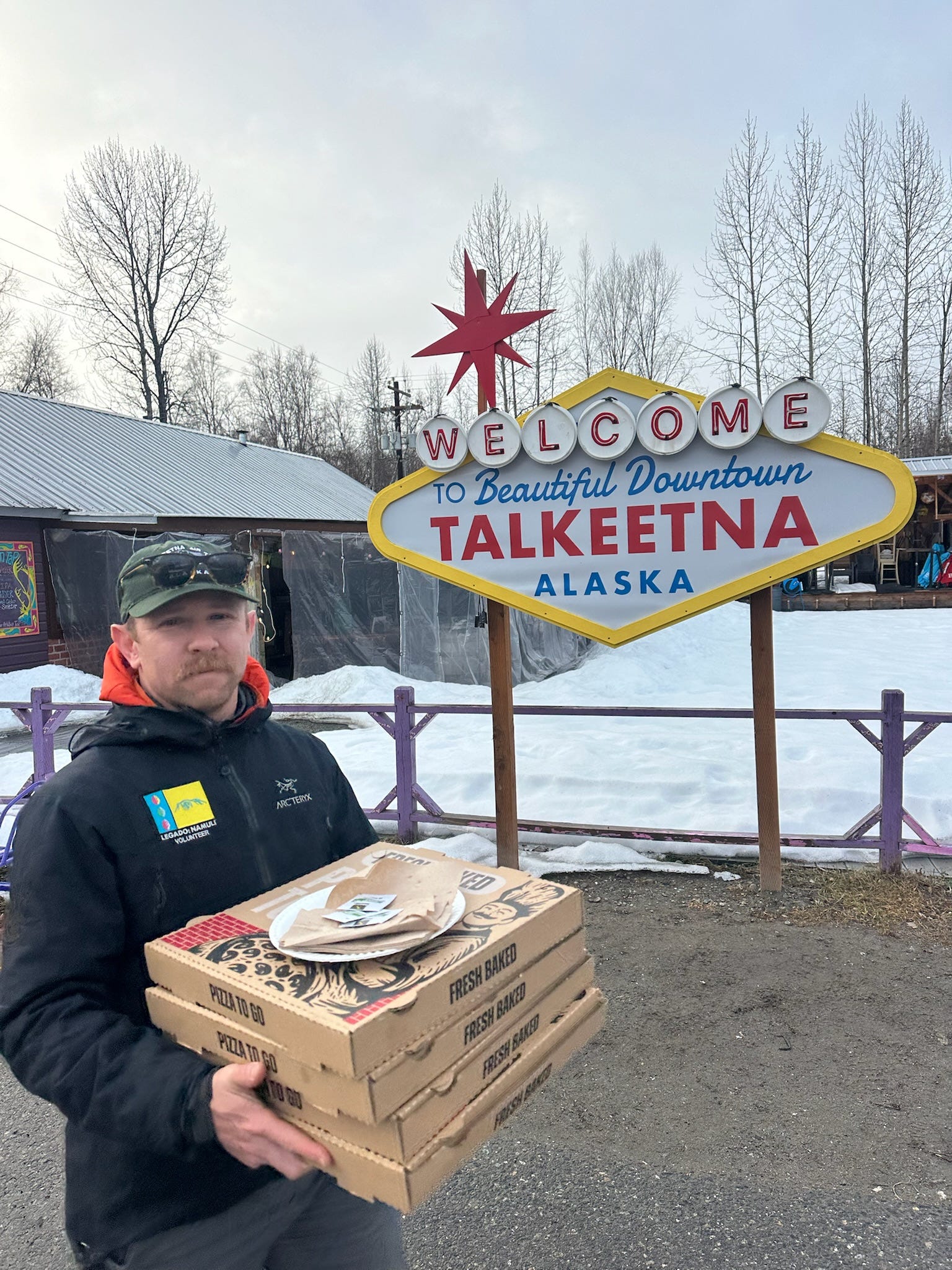
We returned as requested at 11 to an ugly radar. We moped around the hangar for another couple hours before a message electrified the whole airstrip: “Get your shit together because we’re wheels up.” The team squeezed into ski boots, harnessed up, and loaded our thousand pounds of gear, double-checking that the charcoal grill made it into one of the two planes. The engines sputtered to life. Our pilot completed his pre-flight checks. Headphones went on as the propeller roared. Liftoff. We were headed to the Kahiltna Glacier.
Views of the endless Alaska Range and Denali National Park graced my window. As my Otter plane neared the Triple Crown zone a cloudbank obscured the window. The pilot began his descent and, in a dramatic banking turn, peeled back the clouds to reveal rock spires, snow spines, and an endless white glacier just a couple hundred feet below us. Soon, my window went white. My confused, panicked proprioception indicated to my brain that we were, somehow, no longer moving. I looked out the front of the plane and realized we had landed—turns out snow provides a far softer runway than your standard tarmac.
We unloaded our gear (the grill made it) and jumped straight into our skis to avoid sinking into the fresh snow. Dark rock, blinding white snow and ice, and the cerulean sky composed the simple but spectacular color palette of our new world. The three Frenchies from Chamonix that had shared a plane ride with us split off to assemble their own camp a few hundred yards away. We ferried gear, stamped out a campsite, and erected our personal tents and a massive domed cook tent.
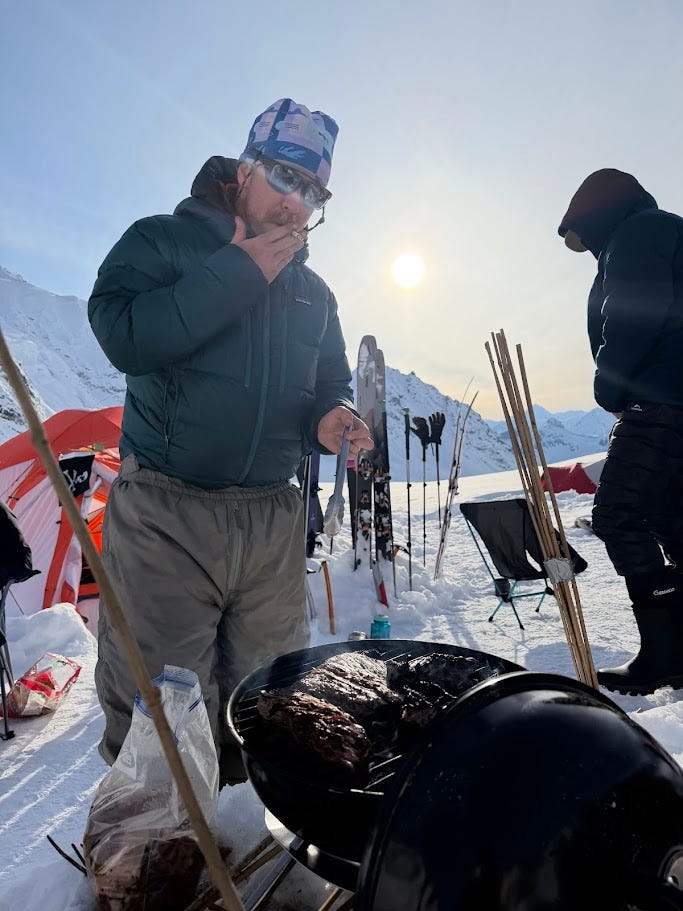
“The work done, the feast laid out, they ate well and no man's hunger lacked a share of the banquet.” — Book 2, Lines 510-511
Camp installed, we stepped into our skis for an evening tour a little after 5pm. Remember, this is Alaska—the sun doesn’t set until 9:30pm each night in April. We walked over to a simple feature three quarters of a mile from camp and snagged two laps and a few hundred feet of skiing on an east-southeast aspect. Five hours before, we had been staring at the ceiling of the hangar at the TAT airstrip, but now we were in the Alaska Range, looking down at our base camp in the middle of a glacier, ringed by mountains. Spines, seracs, and couloirs as far as you could see.
“Like the snow or freezing hail that pelts from clouds when the North Wind born in the clear heaven blasts it on—so in an eager rush of speed the Wind-swift Iris flew.” — Book 15, Lines 203-205
At this point, I am going to abandon any attempt at accurate chronology. It snowed. A lot. Every day and night. More snow than this simple North Carolina boy had known was possible. Our rough measure was on the order of six feet of snow in seven days. Some days when I woke up, I had to use a shovel to dig out of my tent. One morning, Tony and Andrew’s tent was wholly covered by drifted snow.
Now, for the uninitiated, that might sound like great luck: snow on a ski trip! Just what you’re after, right? Well, not quite. It hadn’t snowed in the range the two weeks before we had arrived, so all of the cold north-facing snow had turned into facets. When new snow falls on facets, a slab can form over the weak layer. Borrowing a metaphor from Skiing Unlocked, facets are like champagne glasses supporting a tray; when a skier makes a turn on the slab/tray, the force causes the necks of the champagne glasses to shatter, collapsing the slab onto the next layer below. The broken glass of the facets caused the cohesive tray layer to slide down the slope. In other words: an avalanche. This is bad. In fact, this is how large avalanches happen. And it just so happened that all of the classic steep Alaskan terrain we had hoped to ski was north facing.1
“King Agamemnon answered crisply, ‘Tactics, my noble Menelaus. That’s what we need now, you and I both, and cunning tactics too.’” — Book 10, Lines 49-51
We still skied. Ian pioneered a technique we soon christened the Peterson Piste: placing bamboo wands along the fall line of the slope to allow us some depth perception in the total whiteout, inside-of-a-ping-pong-ball conditions that dominated most days. We had one full day of glorious blue skies and low-angle powder skiing that we took full advantage of (both in terms of skiing and grilling). One day we adventured out to a crevasse field and practiced anchor building and crevasse rescue. But really, a lot of time ended up spent at camp.
I wrote in my journal on Thursday: “Storm day yesterday—we didn’t leave camp. Read, lounged around, built a ‘shit shed,’ ate spaghetti and meatballs, played cribbage.” Those activities, and more banter than most people could handle, made up the balance of the trip. Against Jake’s prediction, it turned out we did have time to read.
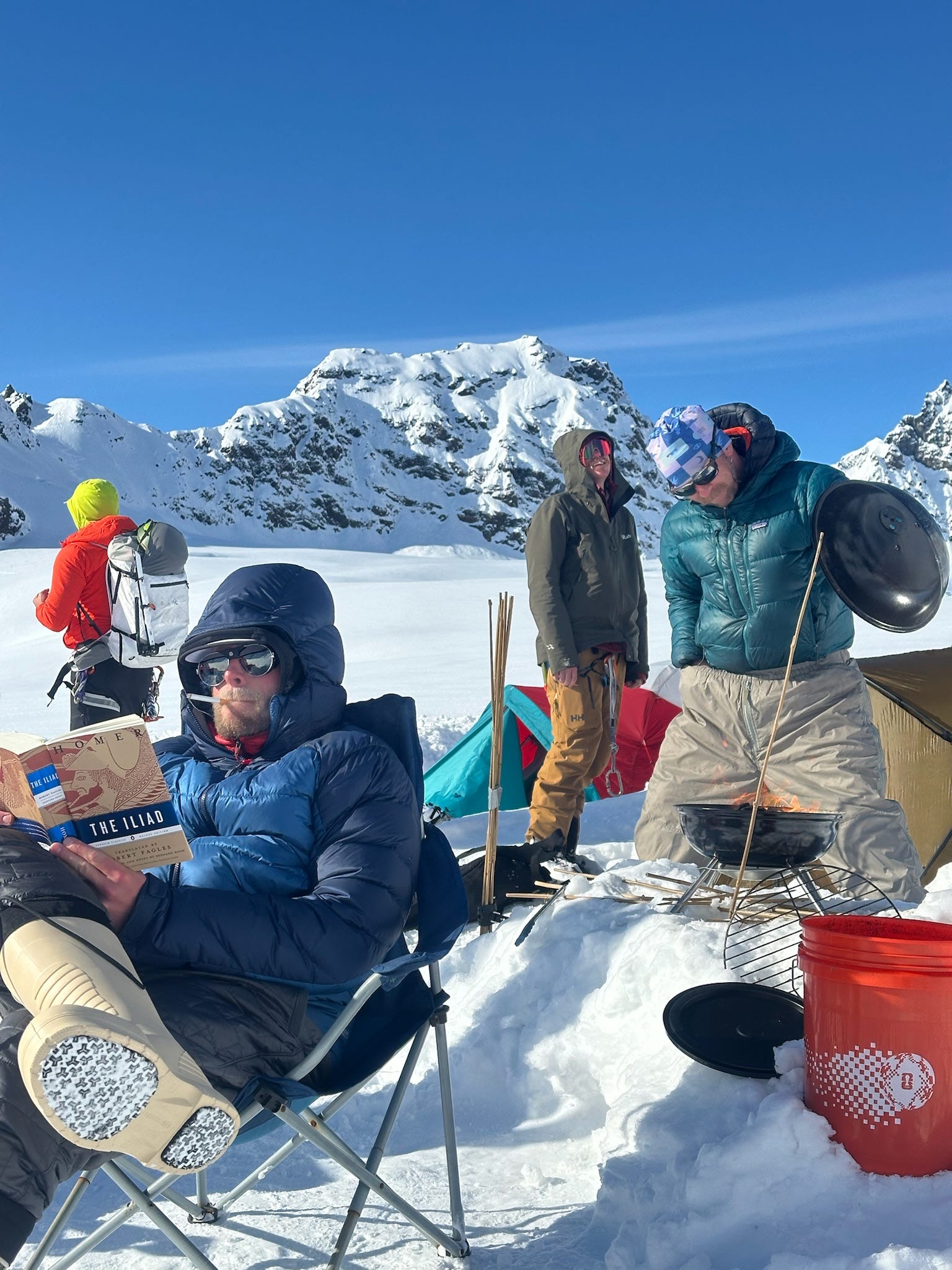
The idea of expectations is what I keep returning to upon reflection. I had none: I was simply happy to be there with two people I think of like brothers and a slew of new friends, ready for anything. But Ian and Ben, as the guides, had serious expectations to manage. They had to assess an immense amount of risk, conducting ad-hoc avalanche forecasting every moment we were out there, while still delivering a product to their clients (i.e., us). And they did it well, maximizing the amount of skiing we could do despite the variables being stacked against us.
“How can you sleep all night, a man weighed down with duties? Your armies turning over their lives to your command, responsibilities so heavy.” — Book 2, Lines 27-29
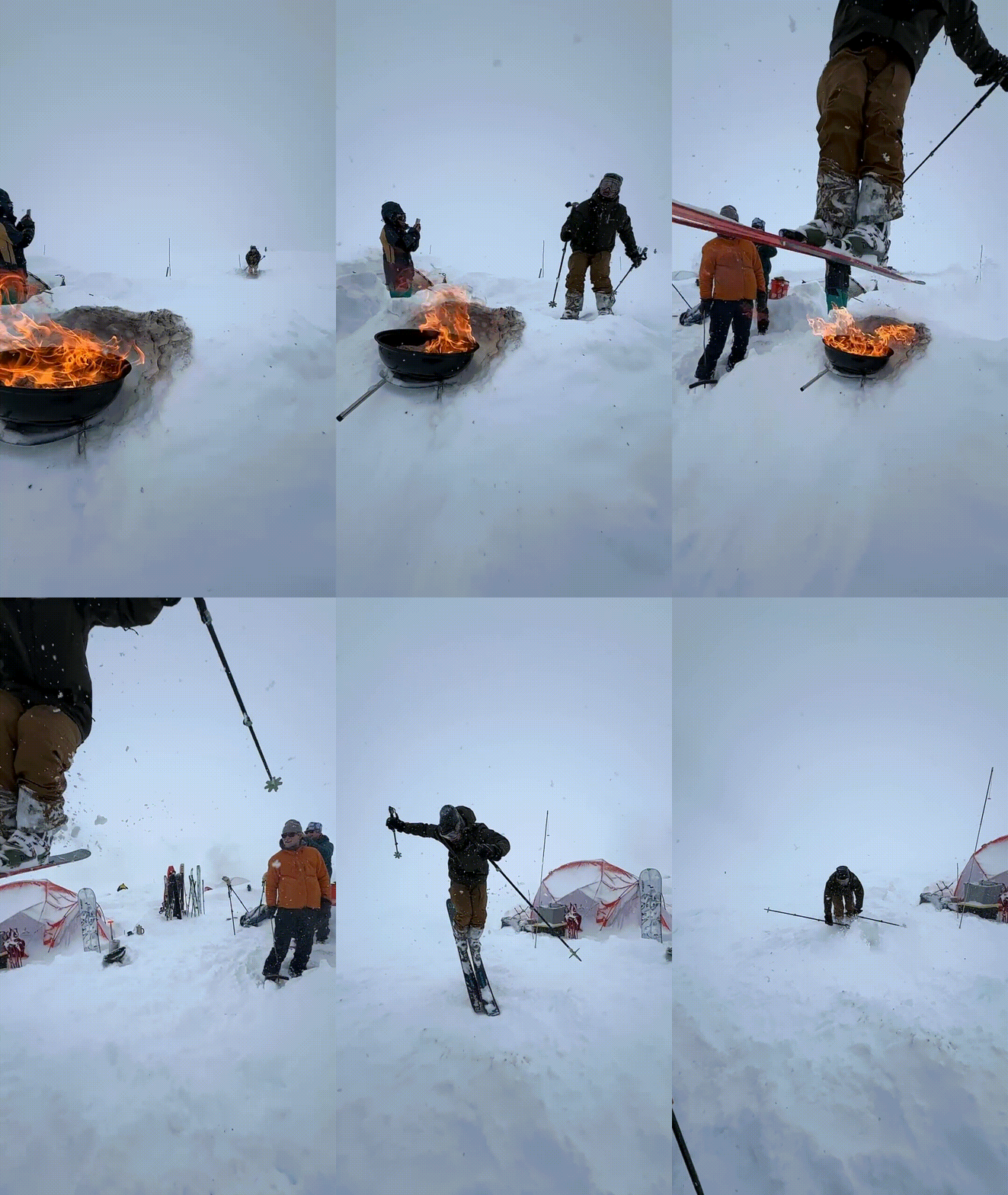
While they constantly collected data, they also had to manage morale. Being tent-bound, in constant sub-zero temperatures, pooping in buckets,2 and boiling snow for water hardly sounds like a vacation for most people. But yet… we had a good time! We ate well. We got really good at cribbage. I read the Iliad. We built a ramp in camp and took turns launching over the flaming grill. We drank whiskey and blasted dozens of hours of reggae and played air guitars and air bass and air drums to Idris Muhammad’s “Could Heaven Ever Be Like This?” We grilled more.


“Come, a bigger winebowl, son of Menoetius, set it here. Mix stronger wine. A cup for the hands of each guest–here beneath my roof are the men I love the most.” — Book 9, Lines 242-245
Toward the end of the trip, when we weren’t sure if we were going to get off the glacier before another big storm socked in and trapped us for another five days, we began getting a little unhinged—we had run out of whiskey, our jokes became even more nonsensical, and the snowdrifts around our tents were becoming large enough to warrant avalanche concerns. I began counting up the calories I had in my personal food stash and surreptitiously eating from my remaining block of cheddar cheese, just in case things got dire. And yet, we held it together. The team stayed sane—at least, as sane as we ever were. I enjoyed myself.
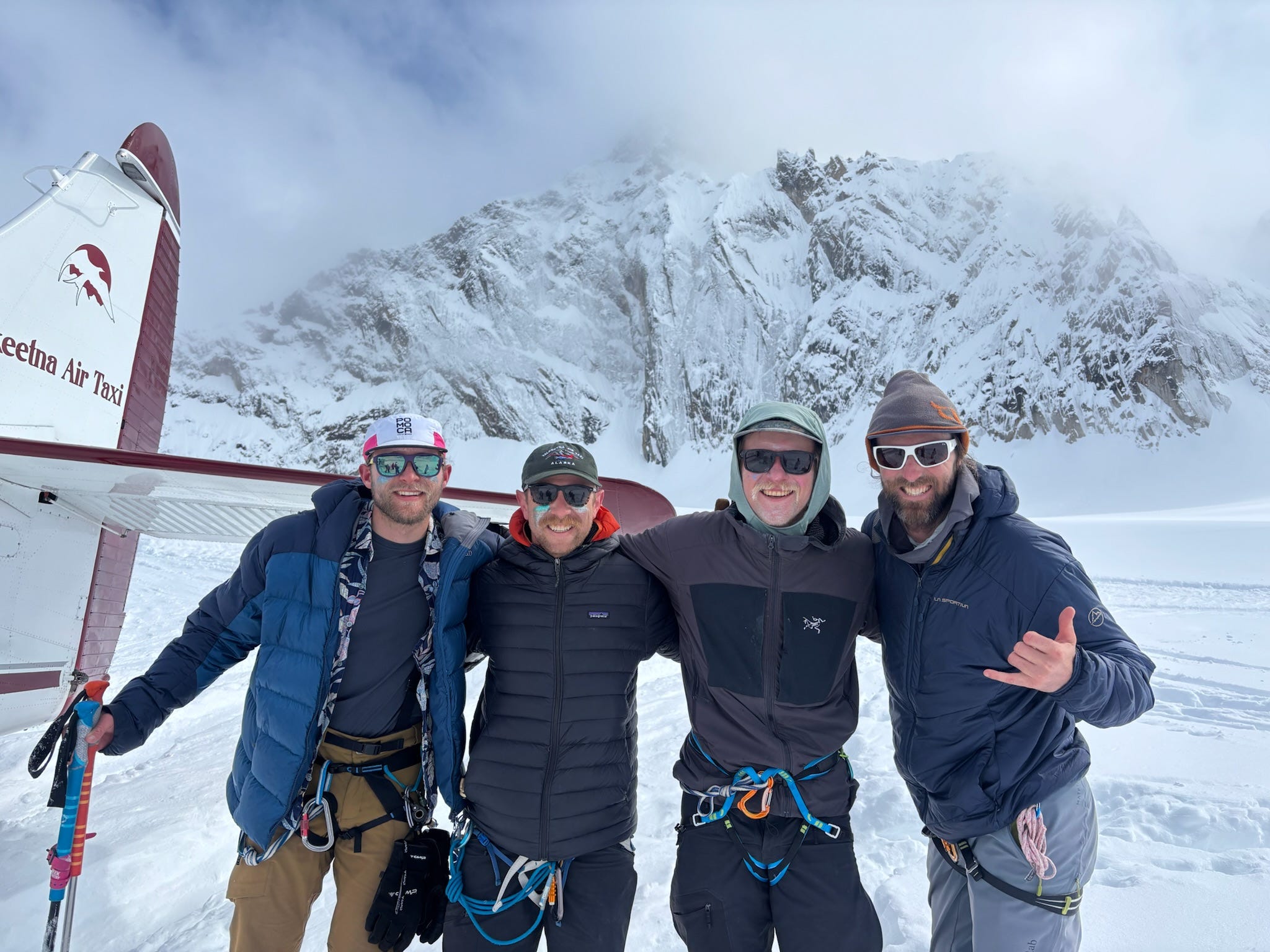
Going on a big trip like this—spending a ton of money, going through heinous logistical hurdles, taking time off work—you hope conditions will be ideal. It would have maybe even been fair to be a little disappointed. But instead, the absurdity of it all wiped clean whatever preconceptions I might have had. What we did was insane! A plane dropped us fifty miles into the wilderness on top of a glacier, where we lived for a week in tents. I got to spend almost two weeks with some of my best friends. The only book I had to read was the Iliad! Literally a book about a bunch of guys camping out, feasting, waiting on the whims of the (weather) gods, and following their heroic leaders (Ben and Ian would be Nestor and Diomedes, respectively).
In retrospect, I don’t really care how many Alaskan spines I didn’t ski. This experience, in all its ridiculousness, was worth a million dollars. Even, especially, the pooping in buckets.
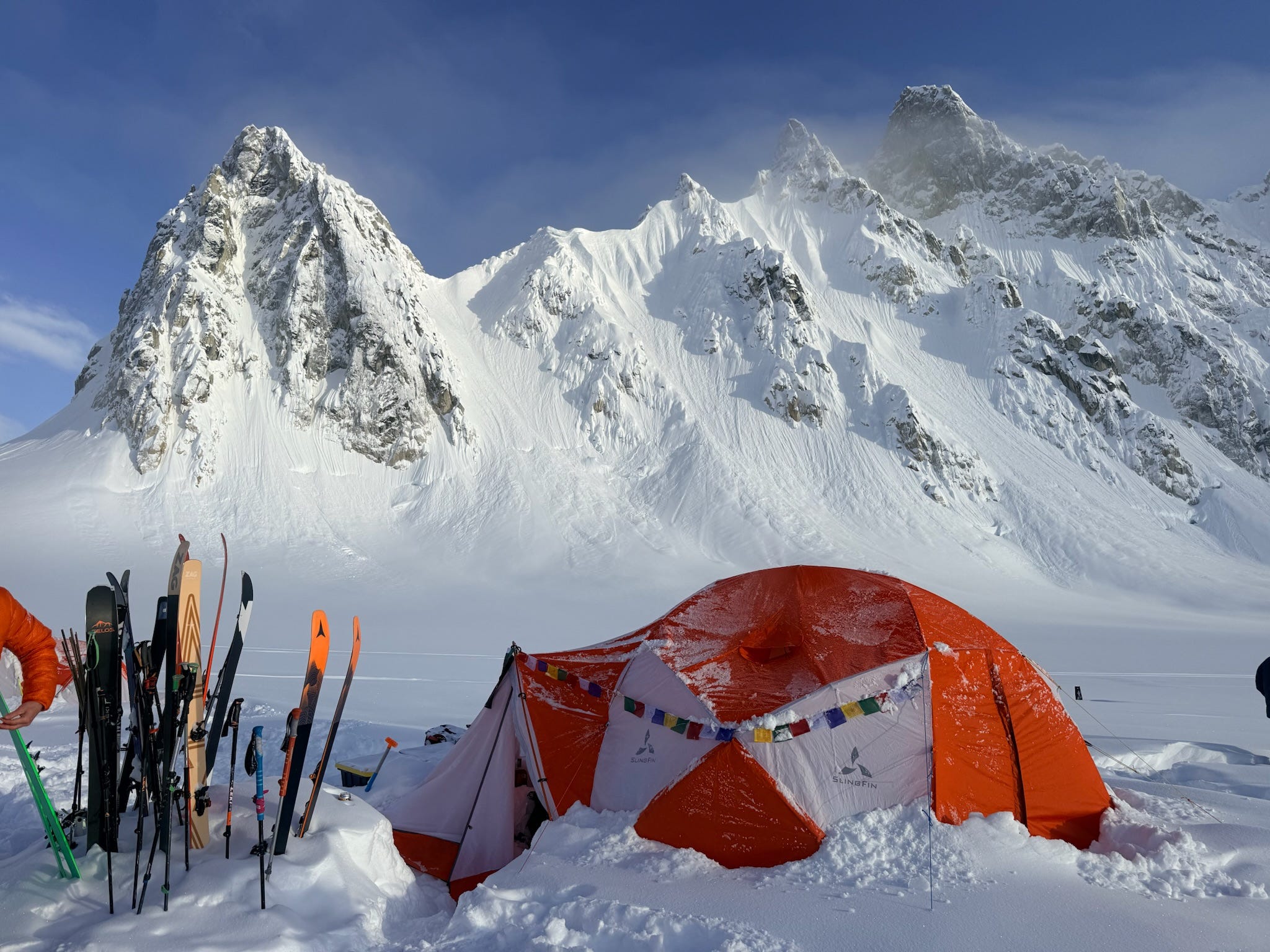
All week from camp, when there was the visibility to see them, the big lines of the Triple Crown dwarfed our campsite. Yes, yes, we couldn’t ski them. All we could do was admire them. But we can always come back next year. And we will.
And you know that.
Thanks to Ian and Ben for keeping us safe. They are two professionals that also know how to run a good bit. If you’re interested in learning more about the mountains, I highly encourage hiring either one of them. Ben is in the Front Range/PNW and Ian is based out of the Tetons, but both run trips around the US and world.
Please tell them I sent you because then they’ll owe me a beer, if not a pitcher.
It was also windy enough that we had the pleasure of contending with wind slabs on certain aspects, and of course storm slabs on the whole compass.
I understand that clean mountain cans need to be portable. But I don’t really understand why they can’t make them just a little bit bigger. A couple extra inches of diameter would go a long way. I won’t elaborate further than by saying by the time we were able to fly out, we were reaching critical levels of fill on most of our allotted cans from the National Park Service. If we had ended up stuck for five more days as was feared, we definitely would have reached code brown.
And you know that.